

A closer look at cellular signals in arthritic joints – Kyburz Lab
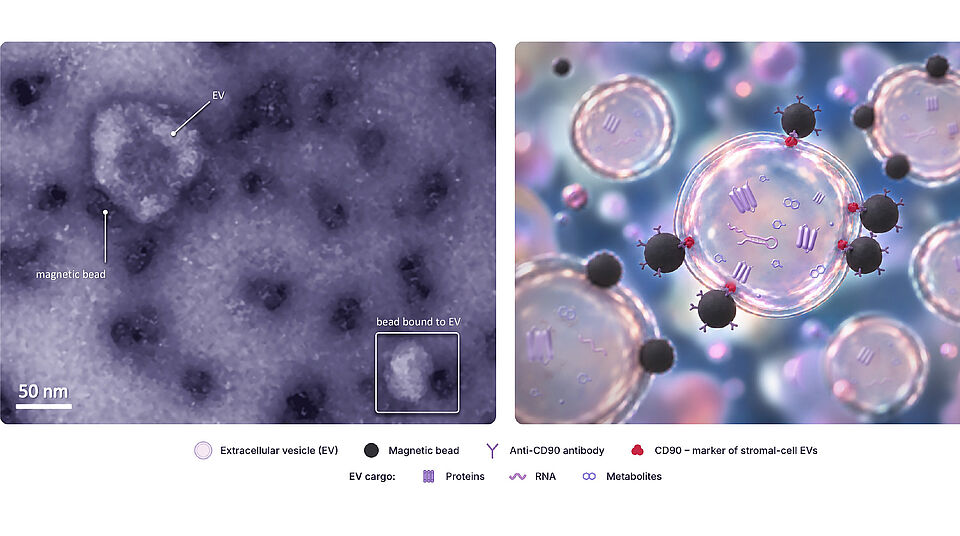
Isolation of stromal cell-derived extracellular vesicles (EVs) from the synovial fluid of arthritis patients. Left: Colourised electron microscopy image of EVs and magnetic beads. Right: Anti-CD90-coated beads selectively capture stromal cell-derived EVs, whose cargo may serve as biomarkers. Image: Kurth et al 2026. Illustration: AI-assisted, not to scale.
Extracellular vesicles (EVs) are small membrane-bound particles released by cells into their surrounding environment. They carry proteins and other molecular cargo reflecting their cellular source and biological state. In inflammatory and degenerative joint diseases, such as rheumatoid arthritis and osteoarthritis, synovial fluid EVs contain valuable information about processes occurring within the affected joint.
However, synovial fluid contains a complex mixture of proteins and EVs released by different cell types, making it difficult to determine which cells contribute specific molecular signals. As first author Stefanie Kurth explains, one of the main challenges is identifying which cell types the EVs originate from.
In a new study published in the Journal of Extracellular Vesicles, Kurth and colleagues from the Kyburz Lab developed a method to isolate and characterize specific cell type-associated subsets of EVs from the synovial fluid of patients with arthritis. The approach combined several separation techniques to enrich EVs carrying the surface marker CD90, which is associated with stromal cells, including fibroblasts. These cells play an important role in inflammation, tissue remodelling, and disease persistence in arthritis.
Kurth and her colleagues used LC-MS/MS proteomics and surfaceome-informed analysis to show that the isolated EV fractions were enriched for proteins associated with stromal cells, while the remaining EVs showed a broader range of immune-associated features.
As the joint senior authors André Nicki Tiaden and Diego Kyburz point out, these findings represent an important step towards exploring EVs as potential biomarkers in arthritis. In the future, such biomarkers could potentially help monitor disease activity and treatment responses.
Read the full study: Kurth et al., Journal of Extracellular Vesicles (2026).