

/ News, Forschung / Martina Konantz
Fear and Antidepressants Trigger Neuron Generation in an Unexpected Brain Region (Taylor Lab)
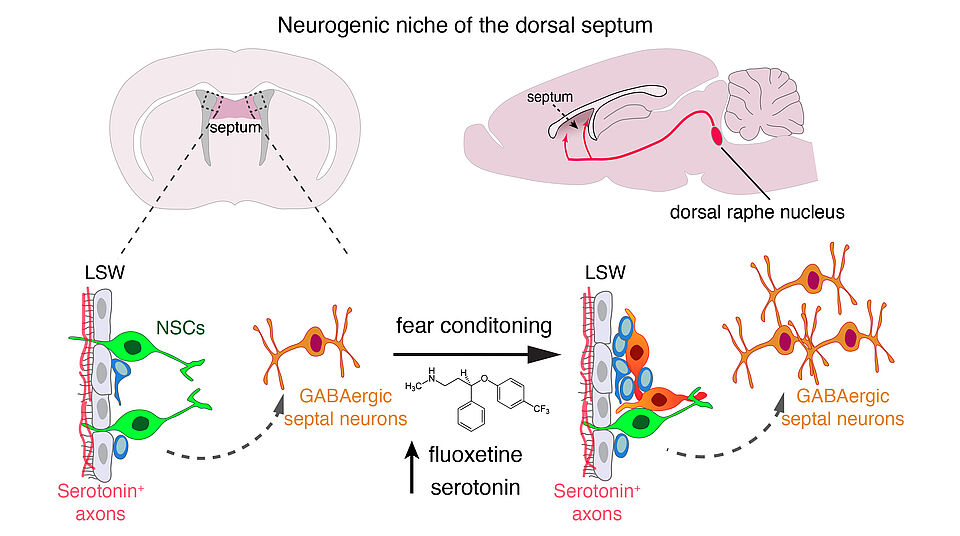
Graphical summary of the neurogenic niche in the lateral septal wall (LSW). Septal neural stem cells (NSCs) are in close proximity to serotonin-positive axons arising from neurons in the dorsal raphe nucleus. Septal NSCs are induced to proliferate and generate local GABAergic septal neurons by fear conditioning and fluoxetine treatment.
Can the adult brain produce new neurons in response to stressful experiences? A new study from the Taylor lab has identified an unexpected population of neural stem cells that becomes activated after stressful experiences and also by antidepressant treatment.
Adult neurogenesis is now recognized to persist throughout life, primarily in a few specialized regions of the mammalian brain. Most research has focused on the hippocampus and, in some species, the olfactory bulb as the main brain regions where new neurons are generated in adults. Now this study, published in Science Advances, provides evidence that the adult mouse septum, a small forebrain structure involved in emotion, memory, and stress regulation, is another site of neurogenesis. Even more intriguing, neuron production in this region was stimulated by both stressful stimuli and the antidepressant fluoxetine.
An Unexpected Neurogenic Niche
The researchers identified a population of neural stem cells (NSCs) residing in the dorsal septum. Under normal conditions, these cells remain largely quiescent. When mice underwent fear conditioning, in which they learned to associate a neutral cue with a mildly unpleasant stimulus, the dorsal septal NSCs became activated and began proliferating. The neurons they produced were GABAergic interneurons, inhibitory cells that dampen excitatory signals in surrounding circuits. Critically, these newborn neurons integrated into and potentially modulated established septal neuronal networks.
Serotonin as the Switch
The dorsal septal NSCs lie adjacent to a dense network of serotonergic axons arising from stress-responsive neurons in the raphe nuclei, the brain's primary source of serotonin. When the team elevated serotonin levels with fluoxetine, the active ingredient in Prozac, they also observed increased cell proliferation and neuron production. Fear conditioning and antidepressant treatment thus induce a similar response in dorsal septal NSCs, and seem to converge on the same mechanism. As the first author Aikaterini Lampada says, the findings "suggest a potential adaptive response in mice to stress-inducing aversive experiences and elevated serotonin in the adult septum."
A New Angle on Depression Research
Adult neurogenesis in the hippocampus has long been linked to mood resilience and antidepressant action - but results from different labs have been inconsistent. The functions of newborn neurons in the adult human brain remain debated. The findings in the septum offer a potentially different viewpoint. The septum’s established roles in anxiety, fear memory, and stress responses make the induced neuron production a compelling candidate for how the brain remodels itself after stressful experiences.
The study was conducted in mice, and whether comparable stem cell populations exist in the human septum remains to be shown. Future work will determine whether these newly generated neurons directly influence fear responses, stress resilience, or other aspects of behavior. In the long term, these insights could potentially help identify new therapeutic targets in depression and anxiety disorders.
The study "Mice produce interneurons in the septum as a response to aversive experiences and antidepressant treatment" by Aikaterini Lampada and colleagues was published on June 10, 2026, in Science Advances (DOI: 10.1126/sciadv.aed3625). The research was carried out at the Department of Biomedicine, University of Basel, in collaboration with the Friedrich Miescher Institute for Biomedical Research (FMI) and colleagues from Yale University and the German Center for Neurodegenerative Diseases.