

/ News, Research / Martina Konantz
Could multimodal tumor profiling at diagnosis change the way we treat ovarian cancer? (Heinzelmann/Jacob Lab)
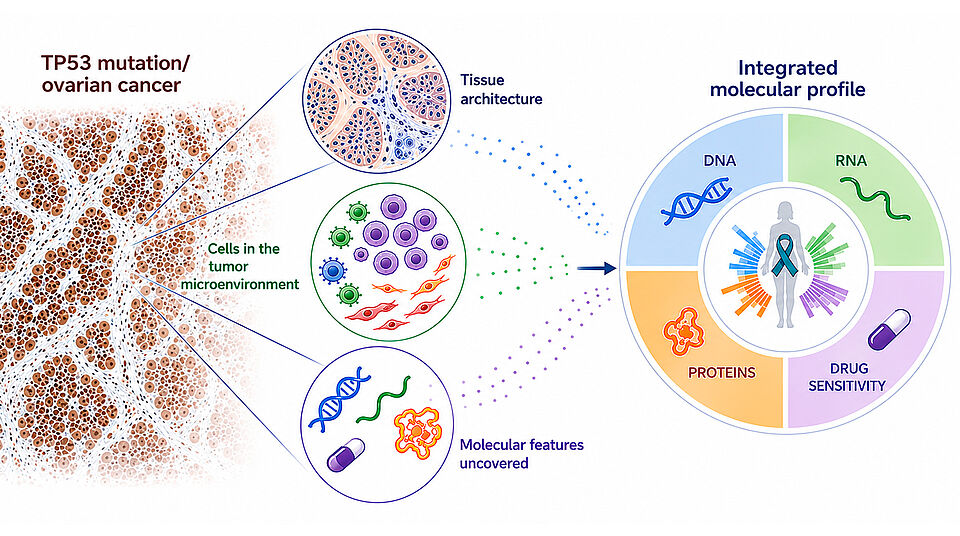
Starting from a routine diagnostic tissue sample, multimodal profiling integrates tissue architecture, the tumor microenvironment, and molecular features into a comprehensive molecular profile of each ovarian cancer, providing a foundation for personalized treatment strategies. Image generated with ChatGPT.
What if the best moment to personalize ovarian cancer treatment is before chemotherapy begins? A major new study suggests that building a detailed molecular picture of each patient's tumor and using it to guide treatment is not only feasible, but may help identify strategies that improve outcomes.
High-grade serous ovarian cancer (HGSOC) is the most common and most deadly form of ovarian cancer. Despite advances in cancer medicine, most women with ovarian cancer still face the same treatment journey: surgery and chemotherapy. But no two tumors are truly alike. Each carries its own mutations, its own mix of immune and cancer cells, and its own vulnerabilities to drugs. For women whose tumors don't respond, five-year survival rates sit between 30 and 40 percent.
Researchers from the Heinzelmann and Jacob lab, as part of the Swiss Tumor Profiler (TuPro) consortium, have put together one of the most detailed molecular portraits of HGSOC to date. Their study analyzed 87 tumor samples from 62 patients using up to eleven technologies simultaneously, covering DNA, RNA, proteins, and live drug testing on tumor cells.
The team used a molecular tumor board, a panel of oncologists, pathologists, and scientists, to review each patient's data and ask whether treatment should be adjusted. With the current routine clinical guidelines alone, more than half of patients showed no reason to change their treatment plan. Once the full TuPro dataset was available, that dropped to just 8 percent, and the share of patients receiving a meaningful adjustment rose from 4 to 37 percent.
“Our proposed framework demonstrates a feasible precision-oncology workflow that can inform treatment decisions beyond standard-of-care therapy,” said first author Francis Jacob.
In newly diagnosed patients, those whose maintenance therapy was adjusted following TuPro review showed longer overall survival than patients whose treatment remained unchanged. Because the study was observational rather than randomized, this finding should be interpreted cautiously. Still, it provides an important signal that personalized approaches deserve prospective testing.
The researchers also looked at what happens to the tumor during treatment itself, comparing samples taken before, after neoadjuvant chemotherapy as well as at the time of disease recurrence. They found that, at a cost: after chemotherapy, tumors became increasingly unique to each patient, drifting apart molecularly, shifting toward more stem-like and adaptable cell states, coinciding with a loss of p53 expression. Rather than converging on a common resistant profile, each tumor appeared to chart its own evolutionary path — further supporting the case against a one-size-fits-all treatment approach.
The implication is pointed: if chemotherapy contributes to the very complexity that makes tumors resistant later on, the best window for personalized intervention may be before it begins. "Molecularly guided treatments merit testing as adjuvant therapies prior to chemotherapy in future trials," said last author and senior investigator Viola Heinzelmann-Schwarz.
The team is now taking this step further, testing the approach in the prospective clinical trial OV Precision (NCT06466382). The challenge of personalized therapy in ovarian cancer is still real, but this work shows the science is catching up, and that the right moment to act may be earlier than previously thought.
The TuPro HGSOC study was conducted within the Swiss Tumor Profiler Consortium, spanning the University Hospital Basel, ETH Zurich, University Hospital Zurich, and partner institutions.