

/ News, Research
How stem cells protect their DNA when changing identity (Schär Lab)
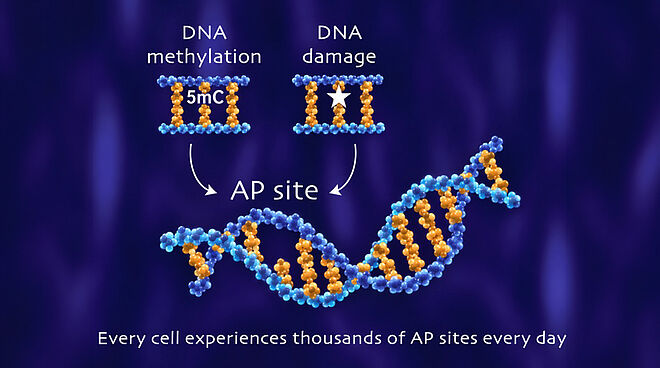
DNA repair meets epigenetic regulation. Abasic (AP) sites are positions in DNA where a base is missing and represent one of the most common DNA lesions. Besides occuring spontaneously, AP sites arise as intermediates in base excision repair, both during the repair of damaged DNA bases and in active DNA demethylation. In the latter process, 5-methylcytosine (5mC) marks are erased as part of epigenetic reprogramming.
The genetic information stored in our cells is constantly exposed to damaging agents, from within and outside the cell. To maintain genome integrity, cells rely on specialized DNA repair pathways. Notably, DNA damage can also arise during normal cellular processes. One such process is active DNA demethylation, which removes chemical marks from DNA to help regulate gene activity during development. This process engages a DNA repair pathway that excises modified DNA bases, generating secondary DNA lesions that require further repair.
In a new study published in Nucleic Acids Research, researchers from the DBM investigated how stem cells repair DNA lesions arising from the excision of modified DNA bases.
When DNA regulation requires DNA repair
The most frequent form of DNA damage are chemical modifications to DNA bases. Consequently, the most active DNA repair system in cells is targeting such damage. This so-called DNA base excision repair (BER) pathway also participates in active DNA demethylation. Both, DNA base damage- or DNA demethylation-induced BER initiate with the targeted excision of a DNA base, generating an abasic site (AP site) in DNA, which is a base-less site. AP sites are the primary target of the endonuclease APE1. Studying APE1 presents challenges, as its loss is lethal in mice and many cell types. To investigate its role in active DNA demethylation, first author Alexandra Hrovat and colleagues generated mouse embryonic stem cells lacking APE1 and develop a system to deplete the upstream acting DNA glycosylase TDG, which controls AP site generation in active DNA demethylation.
“Remarkably, these mouse embryonic stem cells remain viable in their undifferentiated state despite the complete loss of APE1,” explains Hrovat. “This gave us the opportunity to investigate how cells cope with DNA lesions when a central repair enzyme is missing.”
DNA repair becomes critical during differentiation
TDG depletion markedly reduced detectable DNA strand breakage in APE1-deficient stem cells, establishing DNA demethylation as a major source of AP sites in stem cells.
“While the cells can survive without APE1 in their undifferentiated state, they experience severe cell loss when they begin to differentiate,” says Hrovat. “This highlights the importance of processing DNA lesions during the extensive epigenetic reprogramming that accompanies cell differentiation.”
Unexpected DNA repair mechanisms
To identify the cellular pathways that become important in the absence of APE1, the team performed a genome-wide CRISPR knockout screen. Among others, they identified several DNA repair proteins, whose activity proved crucial for the survival of APE1-deficient stem cells. These proteins - MRE11, RAD50 and ATM - are typically associated with responses to DNA double-strand breaks (DSBs) by recombination.
Surprisingly, the researchers found no evidence of increased DSB formation or recombination in these cells. Instead, their findings suggest that the MRN–ATM axis acts outside its canonical role, helping cells to repair or tolerate AP sites through alternative mechanisms.
“These proteins are best known for their roles in responding to DNA double-strand breaks,” explains Primo Schär, who led the study. “Our findings suggest that they also support cells in coping with AP sites when the canonical pathway for repairing these sites is unavailable or saturated. This is particularly relevant in certain stages of cell differentiation or following exposure to genotoxic agents, such as chemotherapies.”
Safeguarding the genome during epigenetic reprogramming
Together, the findings provide the first cellular evidence that active DNA demethylation is a major source of DNA strand breaks in embryonic stem cells, and that these cells depend strongly on APE1 and diverse backup repair activities for survival and differentiation.
Publication: Hrovat et al., Nucleic Acids Research (2026).