

/ News, Events
Official Launch of the Xenium Spatial Transcriptomics Platform
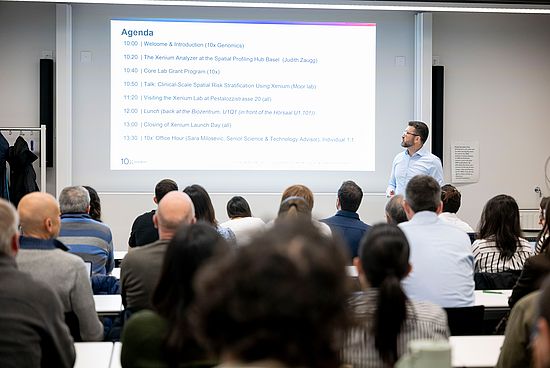
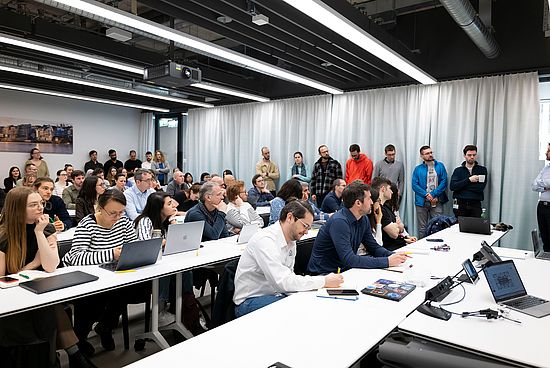
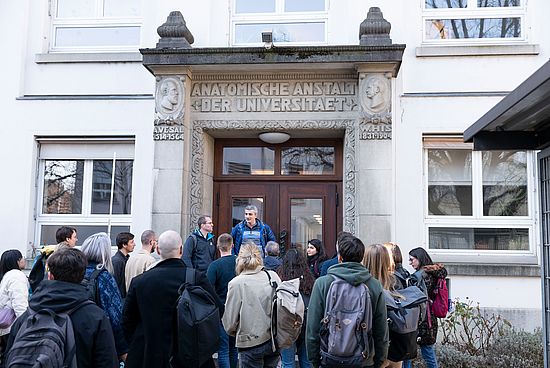
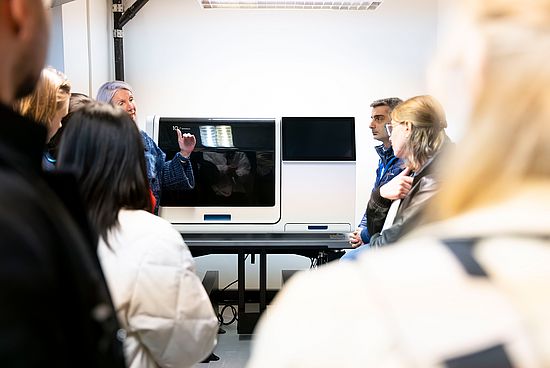






Today, the Department of Biomedicine (DBM) and the ETH Zurich Department of Biosystems Science and Engineering (D-BSSE) officially celebrated the launch of the Xenium spatial transcriptomics platform in Basel. The event marks an important milestone for our research community and further strengthens Basel’s position as a leading center for spatial profiling technologies.
The Xenium system represents a joint investment by the DBM and the D-BSSE. The initiative was co-led by Judith Zaugg at the DBM and Andreas Moor at D-BSSE, implemented in coordination with Diego Calabrese from the DBM histology core facility, and made possible through financial contributions from the DBM and 13 individual research groups across DBM, Pathology, UKBB, and D-BSSE. This broad support reflects the strong bottom-up momentum for spatial transcriptomics in Basel.
Interest in spatial profiling technologies has grown steadily in recent years. The SpatialOmics Symposium 2025, which attracted around 250 participants from academia and industry, clearly demonstrated the high demand for spatially resolved molecular analyses in the region. The establishment of the Xenium platform is a direct response to this scientific need.
Hosted in our histology facility, the Xenium system will operate as a service platform for research groups in Basel and beyond. Details regarding access, pricing, and operational procedures are currently being developed and will be communicated as soon as finalized. As the first academic Xenium platform in Basel, the system is expected to attract significant interest and to become a central component of the Spatial Profiling Landscape Basel.
To mark this milestone, 10x Genomics organized today’s official launch event. The event provided an excellent opportunity to showcase the close collaboration between DBM and D-BSSE and to highlight our shared commitment to advancing spatial profiling approaches that bridge basic and clinical research.
With the installation and launch of the Xenium platform, spatial transcriptomics in Basel enters a new phase. We look forward to supporting innovative projects across disciplines and to further strengthening our collaborative research environment.
Learn more about Xenium technology
Xenium is a high-resolution in situ spatial transcriptomics technology that enables the measurement of gene expression directly within intact tissue sections. By preserving tissue architecture, it allows molecular cell states to be observed in their native spatial and morphological context, bridging gene expression analysis with histology. The technology provides single-cell and subcellular resolution without the need for tissue dissociation, making it possible to localize RNA molecules precisely within complex tissues. Using targeted, high-plex gene panels, Xenium enables the simultaneous measurement of hundreds to thousands of genes, allowing hypothesis-driven interrogation of specific pathways, cell types, and disease-associated programs. Xenium is compatible with both fresh-frozen and formalin-fixed, paraffing-embedded (FFPE) tissue, supporting biomedical research on clinically relevant and archived samples. Its in situ approach makes it particularly powerful for studying spatial heterogeneity, cellular neighborhoods, and cell–cell interactions that cannot be resolved by bulk or dissociated single-cell methods.
By linking molecular programs to tissue organization, spatial transcriptomics provides a spatially resolved view of biology that is essential for understanding complex systems such as tumors, immune niches, and regenerating tissues. This capability enables researchers to move beyond cataloguing cell types toward mechanistic insights into how cellular states and interactions shape tissue function in health and disease and how cells interact with each other in the native context. The technology is particularly well suited for translational studies investigating retrospective cohorts, by allowing high-resolution and high-throughput deep molecular analysis of FFPE-embedded tissue typically stored in pathology departments.