

/ News, Research / Martina Konantz
When the Immune System's Best Soldiers Disappear: New Insight into Why Chronic Infections Defeat Our Antibody Response (Pinschewer Lab)
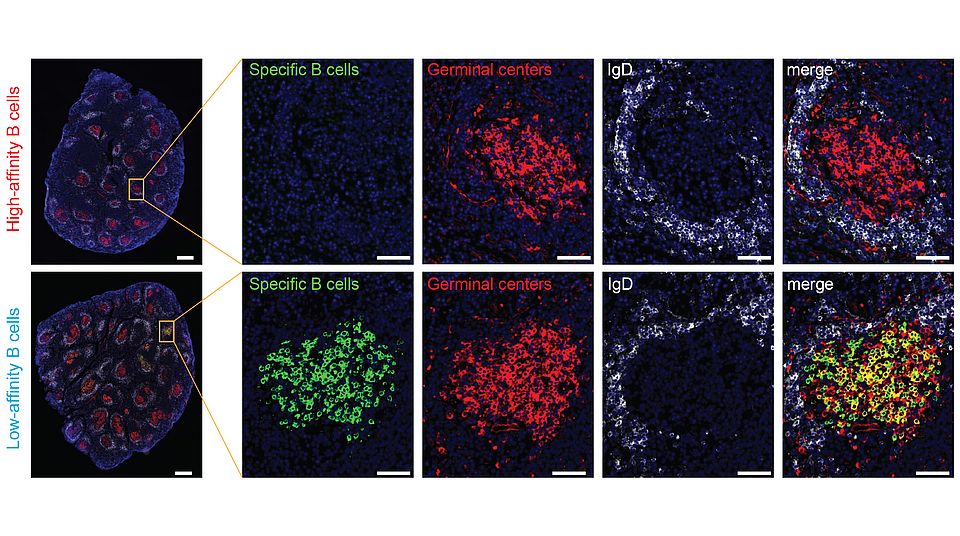
Fluorescence microscopy of mouse spleen tissue comparing chronic infection with a virus to which adoptively transferred B cells bind with high affinity (top) versus infection with a virus bound at low affinity (bottom). Green marks the transferred B cells, red the germinal centers where B cells mature, white the surrounding B cell zone. The difference is striking: B cells bind the persisting virus at high affinity have nearly disappeared from germinal centers by the time of analysis — those B cells binding viral antigen at low affinity persist and populate the germinal center in abundance. (Dimitrova et al., PNAS 2026, Fig. 2H–I. Reproduced under CC BY licence.)
During chronic viral infection, the immune system selectively loses the most potent antibody producing cells while the weaker cells survive, the Pinschewer lab and collaborators show. Intriguingly, it appears, the immune system doesn’t fail to respond but rather suffers from overstimulation.
B cells are crucial for the immune defense against viruses by producing antibodies that bind to and inactivate virus particles. Normally, B cells mature in specialized structures called germinal centers and those with the highest affinity for a virus are selected to proliferate further. In chronic infection, however, this study suggests, affinity maturation fails to bring about the desired result.
The research team investigated what happens when high-affinity B cells that are best equipped to inactivate a virus, encounter persistently high levels of virus. The results were striking: Rather than establishing durable control of the infection, these cells expanded vigorously at the start, but thereafter they contracted and disappeared almost entirely. The authors term this process "attrition." Low-affinity B cells, by contrast, persisted throughout the infection and expanded continuously. "It appears that B cells don’t fail to respond in the first place — it looks more like a consequence of overstimulation," says first author Mirela Dimitrova.
To discover and investigate this phenomenon the team studied lymphocytic choriomeningitis virus (LCMV) infection of mice, a well-established experimental model of chronic viral infection. The researchers introduced very low numbers of B cells bearing high-affinity antibody receptors into chronically infected animals and tracked their fate over time. A consistent pattern emerged: an initial vigorous expansion of the cells, a burst of antibody-secreting cells, then their near-total disappearance.
Importantly, no attrition was observed when the same high-affinity B cells were transferred into acutely rather than chronically infected animals. Attrition was, therefore, not determined by the type of virus, but by the continuous exposure to overwhelming amounts of viral antigen, a key characteristic of chronic infection. To test whether dampening antigen loads could prevent attrition, the team delivered an antibody to capture away the viral antigen. Indeed, this intervention resulted in better survival of high-affinity B cells.
Additionally, the study identified a key molecular driver of attrition. B cells that were destined to attrition showed elevated activity of Blimp-1, a transcription factor that promotes antibody-secreting cell differentiation. When Blimp-1 was genetically ablated in specific B cells, attrition was prevented, suggesting attrition is a B-cell-intrinsic process.
These findings may help explain a long-standing enigma in infectious disease research.
"In chronic infections like HIV or hepatitis C, protective antibodies typically emerge with substantial delay, such that they fail to control the virus in the patient's body. Our work raises the possibility that in the context of chronic infection the immune system selectively loses its best B cell clones owing to an unsustainable response pattern," says senior author Daniel Pinschewer.
How exactly Blimp-1 drives attrition, and how passively administered antibodies prevent attrition will require further investigation. Nevertheless, by discovering attrition as a mechanism of immune subversion in persistent viral infection the study provides a novel perspective on why chronic viral infections evade antibody control, opening up new avenues for therapeutic intervention.