

Translational Immuno-Oncology
The Translational Immuno-Oncology Lab investigates how immune responses are formed, regulated and altered in cancer and infection, and how they can be harnessed to treat disease. By linking fundamental discoveries with patient-centered research, clinical trials and therapeutic development, we aim to understand immune mechanisms leading to treatment failure and resistance and create more precise, durable immunotherapies.
Precision cell therapy (Project Lead: Prof. Dr. Mascha Binder)
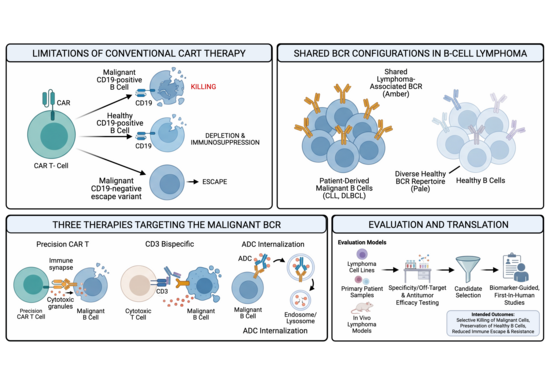
We develop more precise adoptive cell therapies for B and T cell lymphomas. Conventional CAR T cells target lineage markers that are shared by malignant and healthy immune cells, resulting in immunosuppression and enabling tumors to escape through antigen loss. We instead target tumor-specific neoepitopes and recurrent sequence motifs within B and T cell antigen receptors. Because these receptors contribute directly to lymphoma growth and survival, they represent promising targets for preventing immune escape.
Targeting antigen-receptor configurations shared by molecularly defined subgroups of chronic lymphocytic leukemia, diffuse large B cell lymphoma and T cell lymphoma, we develop humanized antigen-binding domains and incorporate them into CAR T cells and bi-specific antibodies or antibody-drug conjugates (ADCs). These therapeutic candidates are evaluated for specificity, off-target activity and antitumor efficacy using lymphoma cell lines, primary patient samples and in vivo models. Our goal is to preserve the healthy immune repertoire, reduce treatment resistance and advance the most promising constructs towards biomarker-guided, first-in-human studies.
Clinical immuno-oncology (Project Lead: Prof. Dr. Mascha Binder)
We regularly conduct translational clinical studies to understand why immune checkpoint blockade benefits only a subset of patients with colorectal, esophagogastric, and head and neck cancers. By integrating tumor and liquid biopsies with immune-repertoire sequencing and inflammatory profiling, we identify mechanisms and predictors of response to guide personalized combination or chemotherapy-free treatment strategies. More information can be found at our DKF homepage.
Formation and recall of antiviral immune memory (Project lead: Dr. Sarah Adamo)
Our research aims to understand how durable immune memory develops following viral infection and vaccination. We focus on the early events that determine the persistence and protective capacity of virus-specific B cells, CD4+ and CD8+ T cells. Coupling longitudinal studies of human infections such as influenza, SARS-CoV-2, and dengue fever, with live-attenuated and mRNA vaccination models, we generate comprehensive “memory maps” to identify cellular states and integrated cellular networks associated with long-term persistence.
We investigate how early signals-including antigen recognition, co-stimulation and cytokines-instruct durable memory using human lymphoid organoids and experimental infection models. In parallel, booster vaccination and re-exposure studies allow us to determine how established human immune memory responds upon recall.
Our goal is to establish early indicators of durable protection, support the identification of vulnerable individuals and provide a foundation for the rational design of vaccines and immunotherapies.
Epitope spreading and endogenous antitumor immunity (Project lead: Dr. Sarah Adamo)
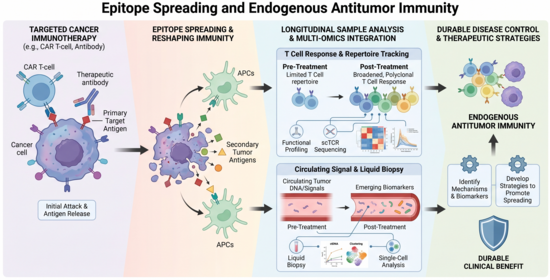
Effective targeted cancer immunotherapy can initiate immune responses that extend beyond the primary target of the treatment. We investigate this process of epitope spreading and ask how therapeutic interventions reshape endogenous antitumor immunity. Using longitudinal samples from patients receiving cellular and antibody-based targeted immunotherapies, we track changes in tumor-specific T cell responses, immune-receptor repertoires and circulating tumor-derived signals before and after treatment.
By integrating functional immune profiling with single-cell analyses, T cell receptor sequencing and liquid-biopsy approaches, we aim to identify when new antitumor responses arise, which tumor antigens they recognize and whether their emergence contributes to durable disease control. Initial studies focus on lymphoma following CAR T-cell therapy, while the broader goal is to establish approaches that can be applied across different tumor entities and therapeutic settings.
Ultimately, we aim to define the mechanisms that allow a targeted therapy to generate broader and more durable endogenous immunity, and to use these insights to develop biomarkers and treatment strategies that actively promote epitope spreading.
Precision immunotherapy for glioblastoma (Project Lead: Dr. Benjamin Thiele)
Glioblastoma is the most aggressive primary brain tumor, and the immunotherapies that changed the outlook in other cancers have so far failed here. A major reason is its microenvironment. Macrophages and microglia make up most of the immune infiltrate, yet the tumor holds them in a suppressed state that shields it from immune attack. We ask which signals maintain this suppression and how it can be reversed.
We test myeloid-directed immunotherapies, alone and in combination, for their ability to restore phagocytosis, inflammatory signaling and antigen presentation, first in cellular models and then in freshly resected tumor tissue and patient-derived models. Spatial and single-cell profiling of the same tumors shows which tissue architectures respond and yields biomarkers for patient selection, and we take the most promising strategies forward into in vivo models.
Our goal is to lay the foundation for early clinical trials and, ultimately, better care for patients with brain tumors.
Tumor microenvironment and resistance to immunotherapy (Project Lead: Dr. Christoph Schultheiss)
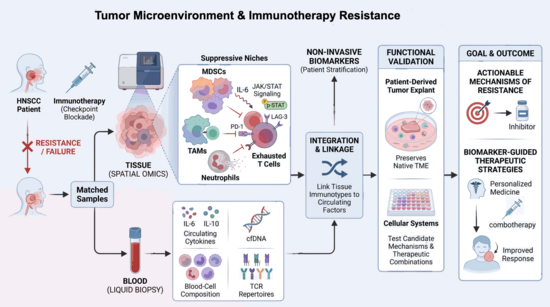
We aim to understand why immune checkpoint blockade fails in many patients with solid tumors, with a particular focus on head and neck squamous cell carcinoma. We combine spatial proteomics and transcriptomics of tumor tissue with matched blood samples and clinical outcomes to identify immune architectures associated with treatment response or resistance. We focus particularly on suppressive niches formed by myeloid-derived suppressor cells, tumor-associated macrophages and neutrophils, as well as their interactions with exhausted T cells and inflammatory pathways such as IL-6/JAK/STAT signaling. By linking these tissue-defined immunotypes to circulating cytokines, cell-free DNA, blood-cell composition and T cell receptor repertoires, we aim to identify non-invasive biomarkers for patient stratification and treatment response. Candidate resistance mechanisms and therapeutic combinations are functionally tested in cellular systems and patient-derived tumor explants that preserve the native immune microenvironment. Our goal is to define actionable mechanisms of resistance and translate them into biomarker-guided therapeutic strategies.
Mutation-antigen receptor networks in lymphoma development (Project Lead: Dr. Christoph Schultheiss)
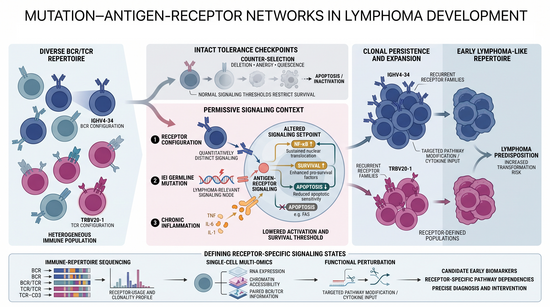
In this project, we investigate how individual mutations alter lymphocyte selection and contribute to the earliest stages of lymphoma development. We study patients with inborn errors of immunity (IEI) carrying germlin mutations in signaling genes that are also recurrently altered in lymphomas. These genetically defined conditions allow us to investigate, for example, how mutations affecting NF-kB signaling, apoptosis and antigen-receptor pathways cooperate with chronic inflammation to promote the survival and expansion of lymphocyte populations that would normally be counter-selected. Using immune-repertoire sequencing, single-cell multi-omics and functional perturbation models, we examine why particular stereotyped B and T cell receptors, including IGHV4-34 and TRBV20-1 families, are repeatedly selected across immune disorders and lymphoid malignancies. Our goal is to define receptor-specific signaling states that predispose lymphocytes to clonal expansion and transformation, thereby identifying early biomarkers and pathway dependencies for more precise diagnosis and intervention.
Recent publications
Schultheiss et al 2026. OncoMimic peptide-based immunotherapy EO2401 induces shared T cell clusters in patients with adrenal cancer.
Communications Medicine
Illerhaus et al 2026. High-dose chemotherapy followed by autologous stem-cell transplan-tation versus non-myeloablative consolidation in primary CNS lymphoma (MATRix/IELSG43): a randomised phase 3 trial.
The Lancet
Adamo et al 2026. Memory T cell aging and rejuvenation.
Immunity
Stein et al 2025. Perioperative pembrolizumab, trastuzumab and FLOT in HER2-positive localized esophagogastric adenocarcinoma: a phase 2 trial.
Nature Medicine